Opening Thursday 28 May, 18.00-20.00
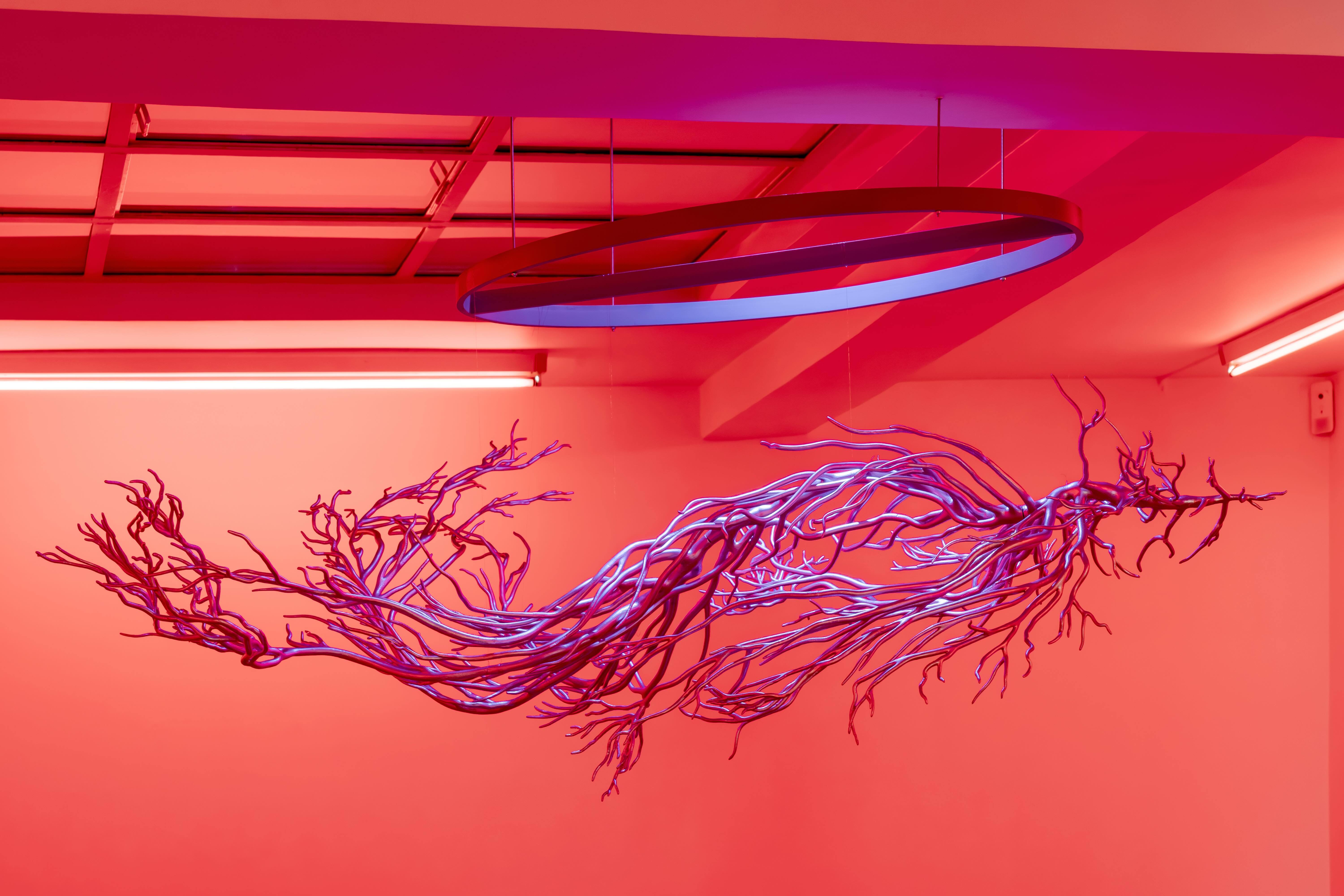
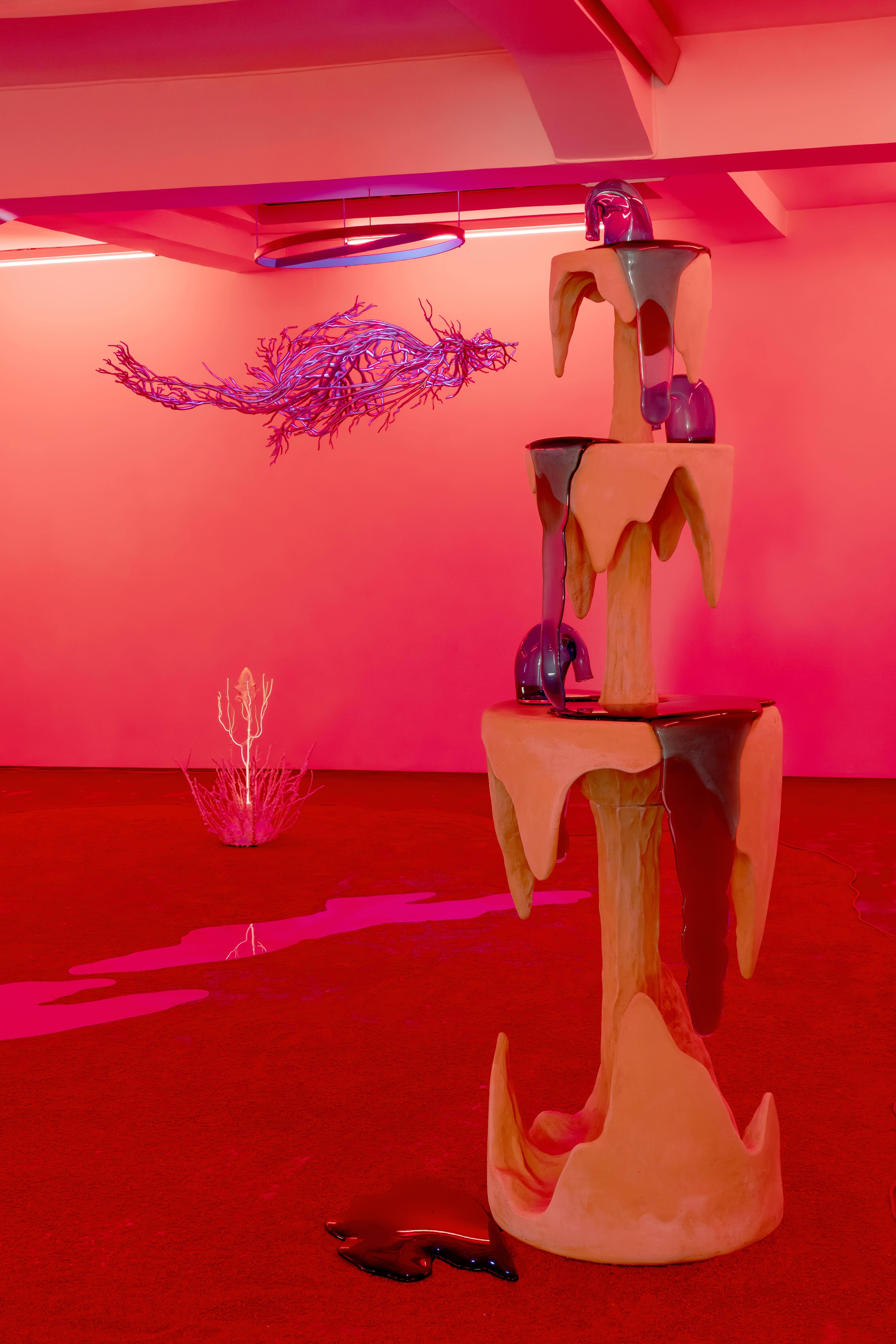
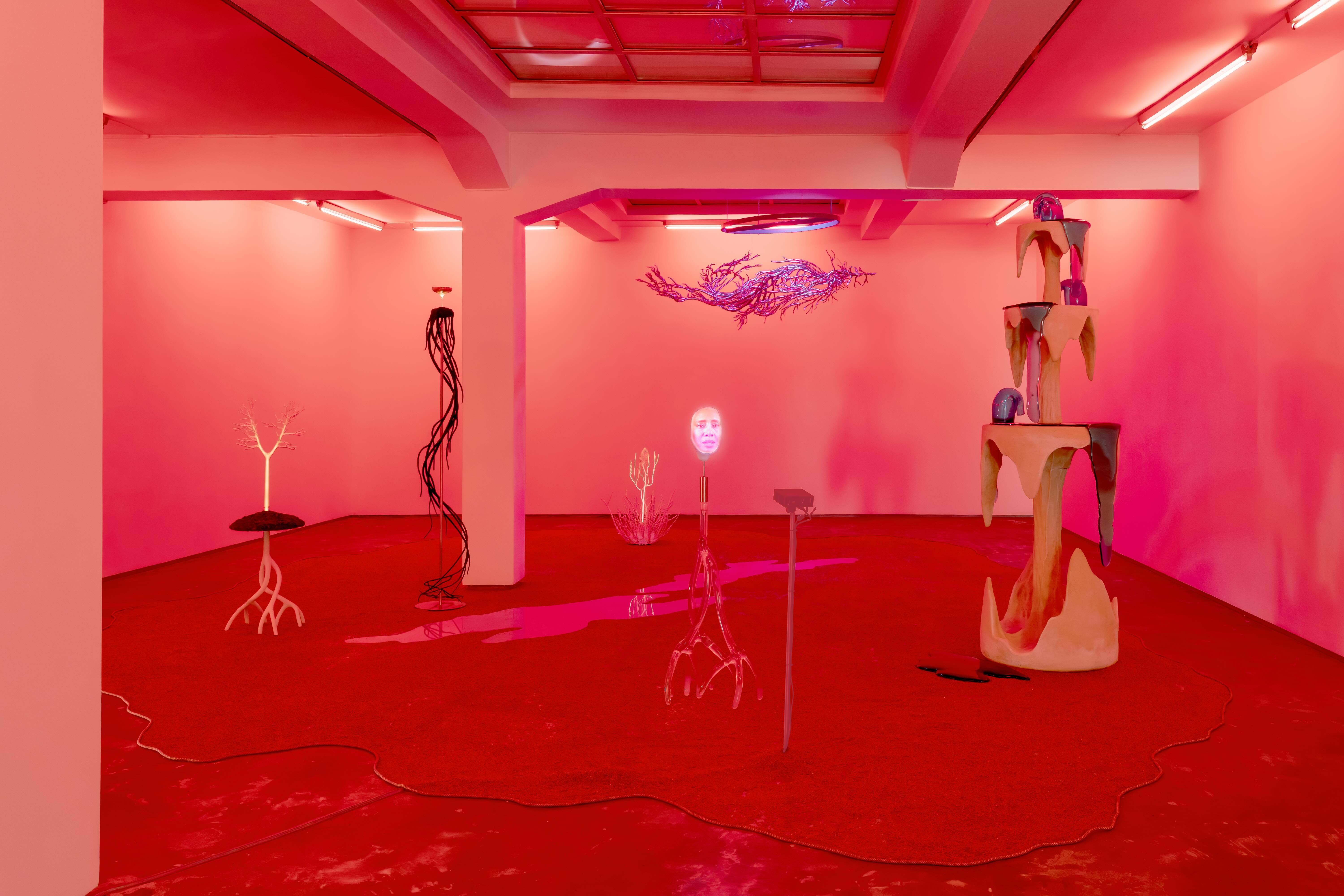
A REALITY MADE OF BREACH is an immersive sculptural installation in which the body is approached as a porous system–shaped by exposure, accumulation, and the slow material consequences of what passes through it. The installation unfolds as a landscape that is also an interior: the sense of being inside a body, or of the body having turned into terrain.
At the center, a figure remains. A face, projected onto a masked sculpture, carries a monologue from within this condition–the body as consequence. Her speech moves between an emerging cosmology, personal history, and the politics of what the body is made to carry. Performed by actress Samantha Lawson, the projected monologue unfolds throughout the space and alternates with a musical composition by May-Oisín Qviller.
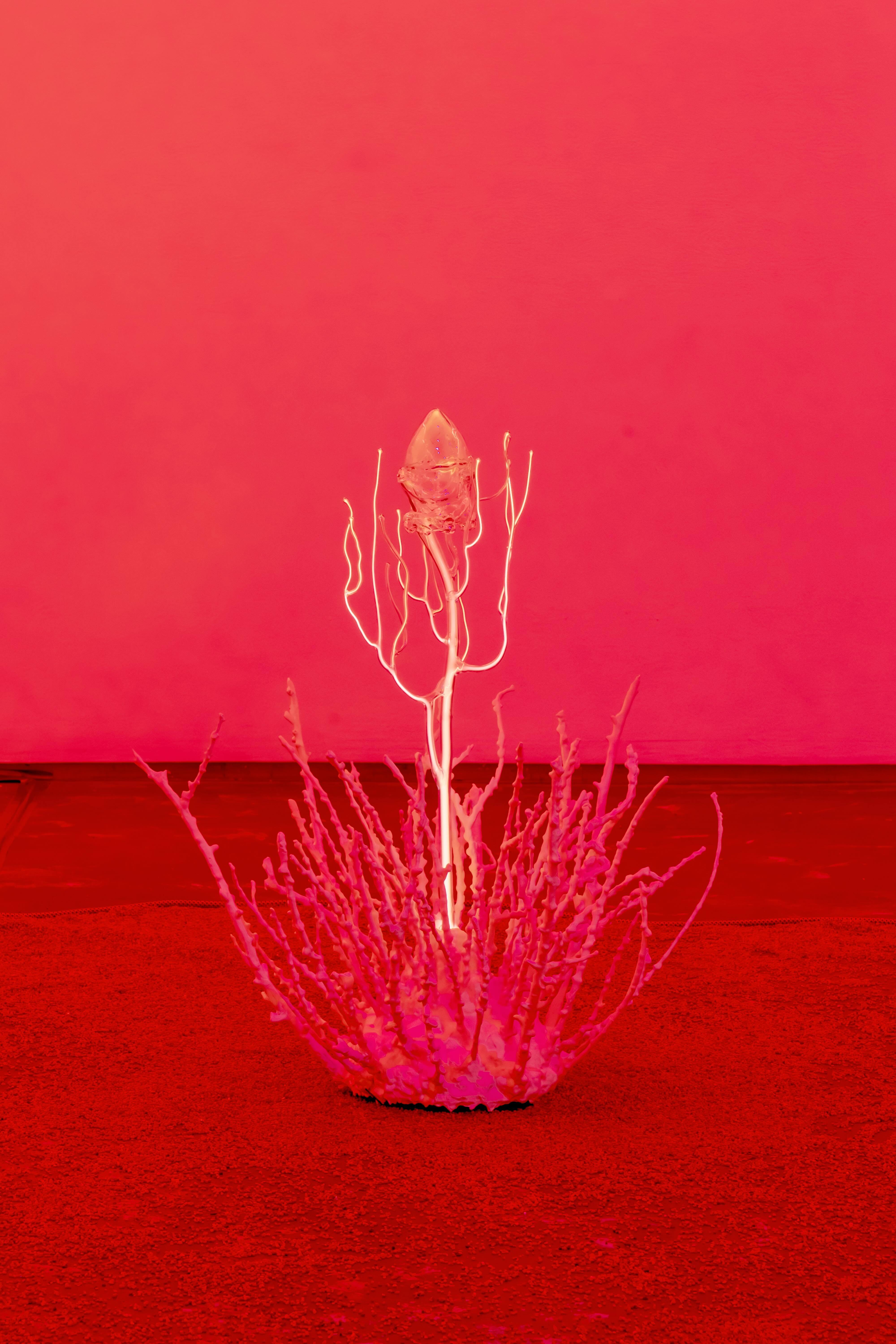
Sculptural forms in glass, metal, neon, and ceramics appear throughout the installation. They resemble lungs, vessels, roots, and neural systems, yet oscillate between identities, their forms held in relation.
A REALITY MADE OF BREACH
A fracture line runs through me. It runs through the matter beneath our surfaces, deep-set. This fracturing of inner selves–and outer shells–runs through the emerging layers of time and material, their faces turned toward one another–in blur. Enter: the slow bleed of one into another. Just so. In the beginning, they say. Throughout what is deemed so–the very beginning–layers of time and material ceaselessly braid into one another like fingers of a hand: here goes time, here goes matter. Zigzag. White-knuckled, through every molecule, their grip runs, their fingers. Deeper than any notion of the mind, this grip and its fracture–deep-set–run through our every nick and hollow. There is nothing else.
In its wake–the mud of life. It gathers (and don’t we know it). Trespasses and fog–they gather. Each face of matter now a continuous blur–nothing is solely mine. And in this besmudged beginning, mass condenses into bodies that feel time through touch. So ardently. And touch through time’s drag. There is nothing else. These tissues carry forward the residue of others’ touch, come what may. Others are kept deep within our matter as epigenetic marks and as molecular memory–and as what comes, already begun.
This fracture–our wound of existence–never was a bleeding one to fix and heal, but our recurring premise. Cracking open yet again and then again, gushing with accumulated states and lived aftermath. Never a bleeding mush you stick your finger into. Not that, no. It is the undercurrent of everything–the material stickiness where contact alters form, where the medium carries the cost of interaction across time. At some point, there is no undoing except becoming undone. The irreversibility and ghastliness of loss–such is our premise.
Loss is alteration beyond recognition. It is the slow rearranging of a body while it still exists. And once gone, someone’s distinct material pattern is no more and will not resurface. This highly singular configuration of matter and process that constituted that person is gone and the finality of that is dark and menacing. I was once a young person whose eye colour broke, sitting through the losses. The density and duration of that room stayed with me, as such things do–rearranging tissue. It does not just visit my body — it is my body, as it sleeps or breathes or stirs.
. . .
And in this altered, crawling materiality of mine–ours–lie deep-set cell structures– organelles, mitochondria and what else–and they form a continuous stream of signals, hums and whistles; minuscule stirrings that try, as they might, to make it all work according to plan, under a script carried through by the forebears. Our line persists as the ghostly presence of our methyl deposits, their long histories of exposure and grief modulating what turns on and off, shaping tendencies and stress cascades. All we thought was simply ours. There it is, their DNA folding and unfolding like tired paper planes made on a rainy afternoon, the sweaty wrinkled papery mess of it coming open in our hands.
And yet lineage is not the only passage. Contact is our atmosphere, through every porous seam of outer layer and mucosal lining. Across the thin films that separate and bind–the membranes I envision as grief’s veils. The translucency and shimmer of loss governing it all—the light retracting in someone’s eyes, ghastly attractive as the iris slackens just so. There is no return to a previous state–and don’t we know it–as the grip of accumulated states hardens toward the end. Something of the other lodges in our endothelium, carried forward with every pulse. Just so, our ports breached.
We were taught there were barriers, protections, thresholds—but things cross, signals pass. I am surely not alone in being smudged by those whose exploitation is mistaken for the way things work, whose greed travels on through matter. Inescapable: the stickiness or even gloom of others, now written into the body too. There’s no avoiding their blunt fingers on my RNA, leaving methyl marks amid other boundary trespasses–our whole reality is made of breach. The air is full of others, of circulating particulate memory and rising cortisol of generations past. And there it is, their residues and stories crossing the blood-brain barrier–who’s a fortress now–fluttering across an inner landscape of us.
Some membranes are made porous beyond measure; some bodies are expected to absorb more. This is not a surprise for those of us who have been breached in all ways since birth and before–enforced exposure moved our epithelial cells intochronic permeability, the fallout of others seeping through our tight junctions–and we are in the thick of it, with intolerances and reactions to freaking everything, as we just don’t want the stickiness of their fingers on us and the body bloody rejects all of it. It is enough. As it has always been enough.
. . .
Ane Graff (b. 1974, Bodø) is informed by feminist new materialisms’ ongoing rethinking of our material reality, in which a relational and process-oriented approach to matter—including the matter of living bodies—plays an integral part. Within this framework, Graff focuses on human and non-human relationships, viewing human beings as part of an expansive, material network, stretching inside and outside of our bodies. Her work traces lines of Western intellectual history and asks how ideas of human exceptionalism, Cartesian dualism and representational thinking all relate to the ecological disasters we face today, and furthermore, what seem to be their current and future implications for material bodies. Graff sees all material bodies as part of an ongoing material experiment, where new substances are being added to the mix (through industrial production and pollution), causing an entangled web of changes and promoting new bodily states. Collaborating with scientists, Graff’s sculptural works often incorporate experimental materials such as bacterial pigments, hair dye, meat glue, phytoestrogens and SSRI antidepressant medications.
Ane Graff lives and works in Oslo, Norway. She graduated from Bergen National Academy of the Arts in 2004 and currently holds a position of PhD Research Fellow at the Oslo National Academy of the Arts. She has been part of exhibitions such as ‘Weather Report–Forecasting Future, Nordic Pavilion’ at the 58th Venice Biennale (curated by Piia Oksanen and Leevi Haapala, KIASMA), 2019; Art Encounters Biennial (curated by Maria Lind & Anca Rujoiu), 2019; Soon Enough: Art in Action, Tensta Konsthall, Stockholm, 2018; Myths of the Marble, Henie Onstad Kunstsenter, Oslo, and the Institute of Contemporary Art, Philadelphia, 2017; the 11th Gwangju Biennale The Eighth Climate (What Does Art Do?), Gwangju, 2016; and Surround Audience, The New Museum Triennial, 2015, NY.
Recent exhibitions include: ‘and we learn to keep the soil wet (group exhibition)’ at CARA, New York City (2023), ‘Ane Graff: The Wound in Its Entanglements’ at Kunstinstituut Melly, Netherlands (2022). ‘Liquid Life’ at Kistefos (2021) (curated by Martha Kirszenbaum), ‘7x7 Stavanger’ as part of the Rhizome/New Museum/Stavanger Kunsthall collaboration (2021); 2021 Liverpool Biennale (curated by Manuela Moscoso).
The exhibition is supported by
Kulturdirektoratet, Billedkunstnernes Vederlagsfond, and Oslo kommune